Opening Times: Monday – Friday: 9am-9pm | Saturday: 9am-1pm | Sunday: 1pm-5pm 

Opening Times: Monday – Friday: 9am-9pm | Saturday: 9am-1pm | Sunday: 1pm-5pm 

Safe Spaces Update – Chair to Step Down

Safe Spaces Update

Governance Update for the Independent Service Supporting Survivors of Church-Related Abuse

Safe Spaces England and Wales (SSEW) today announced that Paul Langham, Independent Chair, has decided to step down after a year of service in the role. This will not affect the running of the service.

Craig Russo BEM, Independent Director, commented on behalf of the SSEW Directors: “We wish Paul all the best as he steps down from his role.”

“We are confident that the service will continue to positively impact the lives of victims and survivors as it develops. This is in no small part due to the representation and participation of survivors on our Advisory Committee and the valuable professional experience they bring to the table.”

“Safe Spaces remains steadfast in its mission to provide a safe and supportive environment for those affected by church-related abuse. The SSEW Directors and the Advisory Committee are committed to ensuring the service’s continued success and positive impact on survivors’ lives.”

Paul Langham will step down in April, following his final meeting as Chair of the Board.

Interim Chair arrangements to ensure a smooth transition will be announced in due course.

The Directors and the Safe Spaces Advisory Committee will continue to work closely together to maintain the high standards of care and support that have been established.

Safe Spaces Update

Safe Spaces Update

We wanted to provide an update regarding the Safe Spaces service.

Martin Christmas Nelson, Safe Spaces Manager, will be leaving Safe Spaces to take up a new role. We want to thank Martin for helping establish what Safe Spaces is today, shaping the service, and ensuring that the values of First Light echo through to the Safe Spaces Service, ensuring everyone is heard, believed, and supported.

We would like to introduce Clair Street as the new Safe Spaces Manager.

Clair joined First Light in April 2024 as the Domestic Abuse and Sexual Violence Support Manager, running the Independent Sexual Violence Advisory service for Devon and Cornwall. She then managed various teams within the integrated Safer Futures Domestic Abuse service in Cornwall. Clair is an experienced manager who has worked in health and social care since 2000 in a range of services and settings, including Drug and Alcohol, Prison Outreach, Homelessness, Community Outreach, and Mental Health.

Again, we want to thank Martin for all his hard work in setting up Safe Spaces and wish him all the best in his new role. We also extend a huge welcome to Clair to the Safe Spaces Team, who will continue the vital work and support we provide.

A Landmark Gathering for the Protection of Minors and Vulnerable Adults

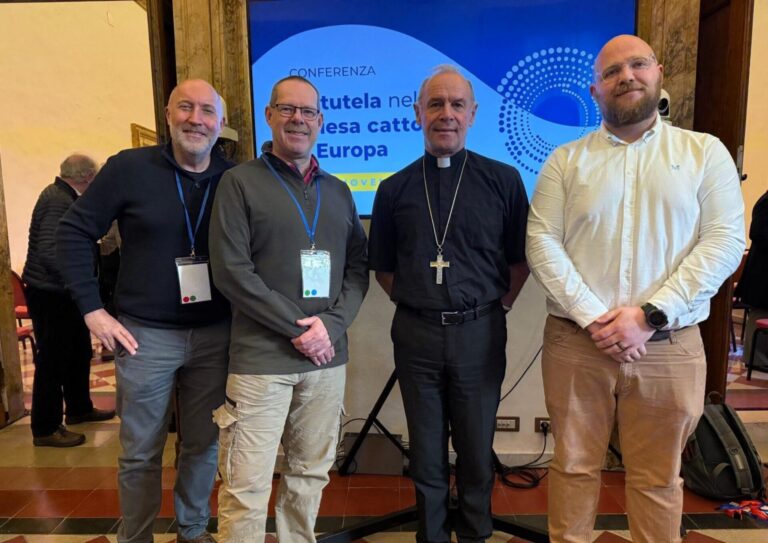
L-R Mick Walker, Director of Safeguarding for Our Lady of Charity of the Good Shepherd.

Steve Ashely, CEO of the Catholic Safeguarding Standards Agency.

Bishop Paul Mason, Bishop to the Armed Forces.

Martin Christmas-Nelson, Safe Spaces Manager

A Landmark Gathering for the Protection of Minors and Vulnerable Adults

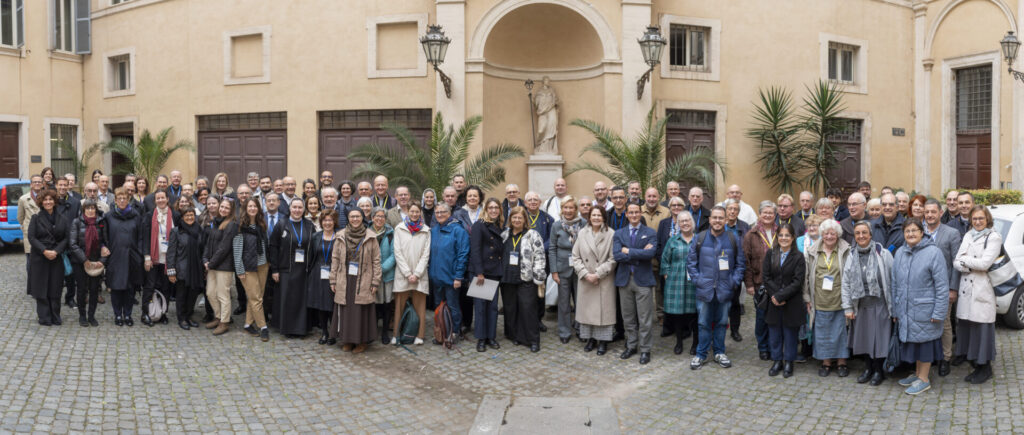
The first-ever European conference dedicated to the protection of minors and vulnerable adults brought together 100 delegates from 25 countries. Participants included survivors, Archbishops, Bishops, Religious leaders, laypeople, academics, independent experts, and others, all committed to safeguarding those at risk. The event also marked the introduction of the Memorae initiative, a new endeavour formed by the Pontifical Commission for the Protection of Minors (PCPM), reinforcing the Church’s commitment to child protection.

Addressing Survivor Trauma and Emotional Complexities

One of the significant aspects of the conference was the open dialogue between survivors and religious psychotherapists. A crucial discussion arose around the complex emotions survivors often experience towards their abusers. One survivor shared their struggle of wanting more children but finding it difficult to engage in an intimate relationship, even with an understanding partner. These deeply personal conversations emphasised the importance of trauma-informed support systems that recognise the long-term emotional impact of abuse.

A Slovakian psychotherapist explored the management of sexual desires and victim responses to trauma, both in the context of the inner self and broader social structures. A key question was raised regarding the creation of a safe buffer zone for survivors of religious trauma—one that allows them to process their experiences without being abandoned or retraumatised by overly authoritative interventions. This discussion highlighted the delicate balance between offering support and ensuring survivors feel neither pressured nor neglected.

Building Safe Societies in Post-Conflict Regions

A critical area of focus was safeguarding children in post-conflict societies, particularly in Bosnia and Herzegovina, where ethnic and religious divisions persist. Delegates examined how safe social systems and youth environments can be created to prevent the exploitation of children in communities fractured by religious and ethnic differences. The discussion included multifaith initiatives, with ongoing work in partnership with JSAS and other religious organisations. The goal is to build bridges between Muslim, Orthodox, and Catholic communities to ensure a unified approach to child protection.

The First PCPM Report and a Survivor-Centred Approach

The conference also saw the presentation of the first PCPM report, sparking essential discussions on the methodologies used to reach out to survivors and the support structures needed to manage these interactions effectively. An insightful analogy was shared: survivors are like individuals at the scene of an accident—those who are silent may be suffering the most and, therefore, require the most careful and compassionate attention.

Dr. Irma Espinoza from Mexico contributed her expertise, discussing how charities and independent survivor organisations can help amplify the voices of quieter survivors, ensuring their needs are prioritised. A follow-up conversation is scheduled to explore how this survivor-first approach can shape the second report, providing a more inclusive and representative account of survivor experiences.

A Collective Mission for the Future

The final day of the conference culminated in the formation of a working group tasked with drafting a mission statement and outlining a strategic direction for future safeguarding efforts. MARTIN CHRISTMAS – NELSON was elected as scribe and spokesperson for this diverse group, which included Bishops, academics, charity CEOs, and safeguarding leads from England, Ireland, Ukraine, and Czechia.

The group’s statement underscored the necessity of collaboration:

“Safeguarding, and learning alike, do not happen in isolation or alone. We are a collective of local, regional, national, and international experts. We need to recognise that nobody moves forward alone, but as a whole. Collaboration is needed to learn from not only our individual successes but our collective failures at all levels, by engaging in dialogue and peer-reviewing good and bad practices first at the local level, then at every other level, concluding with cooperation between the established western churches and the youthful eastern churches, and beyond. The commission needs to ensure that power is given equally to all voices and to empower and amplify positive practice.”

The statement also emphasised the necessity for context-specific safeguarding strategies:

“Safeguarding cannot be franchised or transplanted between cultures, but rather grows in the gaps between our knowledge and practice when we learn to communicate in a common language of protection and safety. We cannot do this alone.”

A Call to Action

This groundbreaking conference laid the foundation for continued dialogue and collaboration in the protection of minors and vulnerable adults. With the introduction of the Memorae initiative and a renewed commitment to survivor-centred methodologies, the work ahead is clear: safeguarding efforts must be collective, survivor-focused, and adaptable to different cultural contexts. The global community must work together to ensure that protection, healing, and justice remain at the forefront of our efforts.
Photograph by Lorenzo Iorfino

Newsletter March 2024

Safe Spaces Newsletter

Quarterly Updates – Issue 2

March 2024

Welcome to Safe Spaces quarterly newsletter!

Thank you for signing up to receive our news! If you have been forwarded this document but want to receive it directly, you can sign up yourself at www.safespacesenglandandwales.org.uk

 This is just our second update since First Light took on responsibility for Safe Spaces in January, but we’ll be making it regular to keep you informed, and give you a chance to have your say about how things are going!

Contact us…

We are available Mon-Friday 0900-2100, Sat 0900-1300 and Sun 1300-1700

By phone: 0300 303 1056

Email: safespaces@firstlight.org.uk

Website and Livechat: www.safespacesenglandandwales.org.uk

Safe Spaces is open, and there are no waiting lists for support.

You do not have to have reported the incident to the Church authorities or the Police in order to access support.

You do not need to be a current active member of the Church in order to access support.

The Rocket Science Report

Towards the end of last year, a contract was signed with Safe Spaces and Rocket Science, who are a market research company, to assess the performance of Safe Spaces since January 2023, when First Light took on the service. You might be aware that Rocket Science did the same thing regarding the initial 2-year pilot scheme and made some recommendations that have formed the core of our approach as we’ve tried to progress the service.

We sent out a questionnaire to everyone who uses Safe Spaces for whom we have an email address on in our records, and Rocket Science also interviewed 8 survivors early this year, and all the staff, including the manager and First Light’s CEO Lyn Gooding to ask our opinions on how the last 12 months or so have gone, what’s been good, what’s been tougher than expected, and lesson to learn for the future.

Having now seen the final draft of the report, we’re pleased with the content, and looking forward to being able to share it soon. There’s still lots to learn and changes we can make, but the feedback of survivors is vital for this, and we’re very grateful. If you’d like to provide feedback for the ongoing Rocket Science research, just get in touch and let us know!

Some further Safe Spaces updates…

Training – Over the last 12 months or so since we took on the Safe Spaces contract, First Light and the staff have all been searching far and wide for additional training to help us all understand the wider picture of abuse within the church, both from church bodies that we have regular contact with, and secular organisations too. This has included training on spiritual abuse, congregation ‘shunning’, LGBTQIA+ awareness including so called ‘conversion therapy’, and very shortly we shall be undertaking training designed to help us support survivors of abuse who also have criminal records or convictions for sexual offenses themselves, so we can work more safely and keep others safer through the work we continue to do.

Peer Support – As per the recommendations in the Rocket Science report for the 2 year pilot operation of Safe Spaces, we’ve started to make plans for peer support spaces provided by Safe Spaces. This isn’t a straightforward process, and we want to get it right and operate it safely, so we started by sending a questionnaire out to our service users, and the results were clear – you want peer support! We’ve now moved onto step 2, which is discussing with a few survivors in a steering group to make sure what we produce meets the needs of survivors, and does so safely. We’ve started to make enquiries too to get staff trained in peer support facilitation, so we can maintain a safe and supportive environment when we do launch the peer support service. We are really excited, and can’t wait to get the service up and running to add another string to our bow, and another way in which you can receive support and share your stories.

Engagement – Now that we’re fully staffed and up to speed with our knowledge and skillsets, we’re pushing on with our plans to further our outreach and engagement work. We’ve looked at our first year’s data and analysed it, to see if there are groups of people who are under-represented in Safe Spaces’ clientele. As such, we’ve seen that young people feature very rarely in our contact and support, and people who identify as coming from non-white British backgrounds. We can’t say too much, but we’ve identified ways we can begin to reach out to these communities, including increasing awareness of Safe Spaces in university and learning areas to appeal to younger people in particular, often living away from home for the first time and thinking about their faith and upbringing. We’ve got other plans afoot too, so watch this space!

Amplifying Survivor’s Voices

Feedback

“In my experience, you’re amazing and I’m more than happy to tell them that you’re instrumental in my healing. The other team members e.g. ***** have been helpful when involved too. You have all been wonderful and supportive.”


 “Your help / support is showing me I am a human being worth listening to.”


 “Sometimes my thoughts about certain emotions surrounding what has taken place in life change because I am healing / recovering. The biggest change in my mind is because of you.”

Survivor Contributions

We’re really keen to give survivors a Safe Space to express themselves and contribute to the recovery and wellbeing of other survivors as well as themselves.

With this in mind, in the future we’d like to dedicate this space to showcasing the insight, musings and myriad talents of the survivors we support.

We’d love to receive poetry, prose, photos of artwork or any other creative endeavours, and any suggestions or helpful tips to help others recover and thrive as you have done. Email anything relevant to safespaces@firstlight.org.uk or directly to your Survivor Advocate and we’ll gladly and proudly share it here.

Closing thoughts from the Safe Spaces manager

Thank you, once again, for your continued interest, feedback and support of Safe Spaces. Our staff work very hard to help people, and every little bit of feedback and encouragement we receive to remind us it’s appreciated goes a very long way.

Thank you also to those of you who completed the Rocket Science questionnaire and who provided more detailed feedback if you were asked. We look forward to asking more of you to participate in the second year of the project.

Thank you also to our partner agencies and commissioners for your help and guidance, and I hope you’re all having as good a start to 2024 as has been possible, in spit of the incessant rain!

Sincerely, Martin Christmas-Nelson

Newsletter November2023

Safe Spaces Newsletter

Quarterly Updates – Issue 1

November 2023

Welcome to Safe Spaces quarterly newsletter!

Thank you for signing up to receive our news! If you have been forwarded this document but want to receive it directly, you can sign up yourself at www.safespacesenglandandwales.org.uk

This is our first update since First Light took on responsibility for Safe Spaces in January, but we’ll be making it regular to keep you informed, and give you a chance to have your say about how things are going!

Contact us…

We are available Mon-Friday 0900-2100, Sat 0900-1300 and Sun 1300-1700

By phone: 0300 303 1056

Email: safespaces@firstlight.org.uk

Website and Livechat: www.safespacesenglandandwales.org.uk

Safe Spaces is open, and there are no waiting lists for support.

You do not have to have reported the incident to the Church authorities or the Police in order to access support.

You do not need to be a current active member of the Church in order to access support.

Some good news…

Since January, we’ve been aware that the Safe Spaces website is outdated, confusing and unclear. It has been an ongoing task to overhaul it and bring it into the 21st century and we’ve finally managed it!

The new website design has incorporated user feedback, input from other professionals, and a lot of hard work from First Light’s Communications Officer, and as a result features more concise and accurate information, a clearer layout, and much faster access to the resources that you might need, both inside and outside of our working hours.

Most importantly, it now features an online referral form, making it easier for survivors, professionals and anyone else to submit a referral to Safe Spaces, and for us to make sure all the information we need is clearly and accurately recorded, helping us to improve the quality of our support.

We hope you’re as happy with it as we are, but if you have any comments     or suggestions to improve it,                 let us know by emailing safespaces@firstlight.org.uk and we’ll do what we can!

Some further Safe Spaces updates…

Staffing – Since we took on the Safe Spaces contract in January, our staffing numbers have been steadily increasing to deal with demand. We’re delighted to say that we now have a full complement of staff working full time for Safe Spaces, consisting of a manager, 2 Support Advisors to operate the helpline, webchat and triage our new contacts, and 3 Survivor Advocates who provide longer term support to survivors. Thanks is due to all the survivors who offered to help during recruitment processes, from writing questions to sitting on interview panels. It’s wonderful to be able to use survivor voices to shape the service.  Information and bios for our staff are now available on the website. All staff continue to receive specialist training from secular and non-secular sources to further their understanding of church-related abuse. In addition, we have a pool of experienced staff who work on our out of hours helpline service.


Demand – Our service has steadily grown since January, reflecting the increase in demand and growing awareness of Safe Spaces. When our contract began, we inherited 43 survivor cases, and that number has now grown to 90 open cases being supported. We’re very proud of this growth, but also acutely aware that this is still just a drop in the ocean when considering the number of people who would benefit from our support, so we’re determined to grow further in the future.


Growth – As a combination of our successful recruitment and increased demand, we’ve now formulated a structured plan to further extend our reach and awareness of Safe Spaces, in particular within non-religious institutions so that we can reach those affected by abuse who no longer have a connection to the church. All our staff are now busy contacting a wide range of agencies including the police, Department for Work and Pensions, social care, Local Authorities, other charities and not-for-profit organisations, as well as strengthening our understanding and cooperation with Diocesan and Cathedral Safeguarding teams within the Church  of England, Church in Wales and Catholic Church in England and Wales. This has created opportunities to deliver talks, seminars and training sessions to raise awareness of church-related abuse and its impact, as well as the important role Safe Spaces can play in providing support to people who have been abused.

Amplifying Survivor’s Voices

Feedback

“Thank you for checking in and all the support you and Safe Spaces are giving me. I don’t think I’d be able to do this without you.”

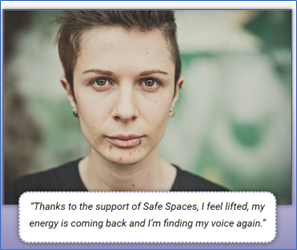
“Thanks to the support of Safe Spaces, I feel lifted, my energy is coming back and I’m finding my voice again.”

“Thank you, Safe Spaces! I had a completely LIFE CHANGING call yesterday on the out of hours helpline. All of you are doing such an amazing job.  
I can’t thank you all enough.”

“I had felt like I was being prideful and arrogant for expressing anger and wanting vengeance toward the perpetrator. My Safe Spaces advocate helping me understand that this was my right to receive justice helped me move forward and feel”

Survivor Contributions

We’re really keen to give survivors a Safe Space to express themselves and contribute to the recovery and wellbeing of other survivors as well as themselves.

With this in mind, in the future we’d like to dedicate this space to showcasing the insight, musings and myriad talents of the survivors we support.

We’d love to receive poetry, prose, photos of artwork or any other creative endeavours, and any suggestions or helpful tips to help others recover and thrive as you have done. Email anything relevant to safespaces@firstlight.org.uk or directly to your Survivor Advocate and we’ll gladly and proudly share it here.

Closing thoughts from the Safe Spaces manager

Firstly, I’d like to thank you all for your continuing support and belief in Safe spaces as a force for good. It’s been a steep learning curve for First Light and for myself since we took on Safe Spaces in January, and I feel like we’re on the right track and making improvements as we learn and grow. The continued input and belief from survivors makes this much easier, and I’m eternally grateful for the help we’ve had along the way from you!

It’s been an honour and privilege to have the opportunity to help such a wonderful and diverse survivor group, and I look forward to working closely with many survivors in the future to continue to grow and develop our service to help even more people.

Sincerely,

Martin Christmas-Nelson (Safe Spaces manager)